
National workshop on "Preparation and readiness to respond to events related to nuclear incidents in neighboring countries"
Within the framework of the Asian Nuclear Safety Network (ANSN), a National Workshop on Preparedness and Response Arrangements for Events Involving a Nuclear Emergency in a Neighboring Country was held at the Institute for Nuclear Science and Technology (INST), Hanoi, Vietnam, from 27 to 29 August 2018. The workshop was hosted by INST, in cooperation with the International Atomic Energy Agency (IAEA).
The workshop was intended to provide participants with the IAEA requirements and recommendations on emergency preparedness and response (EPR) for developing adequate and harmonized capabilities as well as establishing preparedness and response arrangements for effective response to a nuclear emergency originating from a neighboring country.
This is the first national workshop, at which transnational nuclear emergency response, one of the ten disaster risks identified for Hanoi, has been discussed in great detail.
Two IAEA experts and more than 30 participants from Vietnamese organizations, including Vietnam Atomic Energy Institute, Vietnam Agency for Radiation and Nuclear Safety, Institute for Nuclear Science and Technology, Nuclear Training Center, and Center for Technology Environmental Treatment, took part in the workshop.
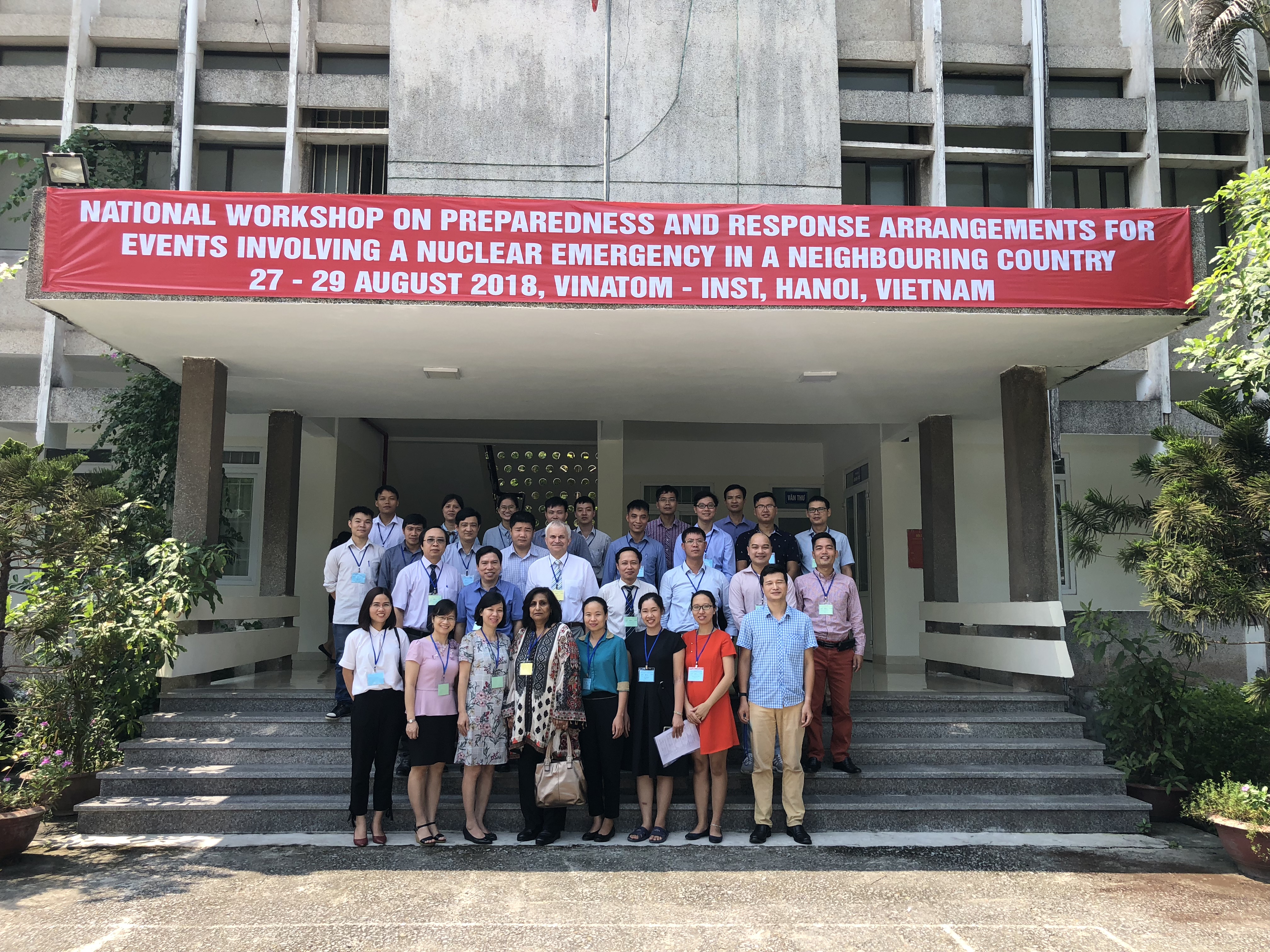
Participants at the workshop
The agenda of the three-day event included lectures, discussions and national experience sharing in the coordination of preparedness and response arrangements for a nuclear emergency originating from a neighboring country. All of the activities, taking place at the workshop, provided the participants with extensive knowledge of the following issues:
- Current status and future development of Safety Guides on EPR, and concept of operations for a nuclear or radiological emergency in EPC V;
- Requirements on preparedness and response arrangements for a nuclear emergency in line with the IAEA Safety Standards Series No. GSR Part 7;
- National preparedness and response arrangements for a transnational emergency, and current efforts to improve the coordination with neighboring countries;
- Roles of the IAEA in emergency preparedness and response;
- Communicating with the public in a nuclear or radiological emergency and protective actions for an emergency at a nuclear power plant;
- Coordination of emergency preparedness and response;
- National experience in transboundary coordination of EPR arrangements (examples of Slovenia and Pakistan).
During the course of the workshop, three working sessions were conducted in such a way that the participants could practise and apply the skills/knowledge gained throughout the lectures on EPR arrangements for effective response to an emergency originating from a neighboring country in specific scenarios. The participants were divided into small groups to deal with three exercises on identifying protective actions or other response actions in the context of three transboundary nuclear emergency scenarios at different distances fairly consistent with Vietnam’s current status.
Based on the knowledge, skills and experience in EPR arrangements shared at the workshop, it is recommended that to improve the coordination of adequate preparedness and response arrangements for effective response to a nuclear emergency in a neighboring country, external coordination and other assistance with local and overseas regulatory authorities should be further enhanced through the implementation of practical activities such as prediction and warning, education and training, technology transfer, information exchange, sharing experience and lessons learned from past emergencies and exercises. In addition, it is necessary to facilitate external cooperation with international agencies regarding the deployment of preparedness and response planning for a nuclear or radiological emergency or even a natural disaster.
INST


.png)