

Evaluations of Volatile Iodine in Pool under Severe Accident Condition
In the research field on severe accidents in Nuclear Power Plant (NPP), most of studies on Source Term have been focused on the evaluation of potential radioactive releases to the environment in a relatively short term, i.e. when the releases are the most important. Concerning the iodine behavior in the containment, theNUREG-1465 concludes that the chemical form of iodine entering containmentfrom the reactor coolant system is composed of atleast 95% of CsI, with no more than 5% of I plus HIenter reactor a containmentfrom the reactor coolant system . However, under accident conditions, nonvolatile I- initially dissolved in the sump will be oxidized by radiolytic processes, and finally form volatile molecular iodine that could be re-vaporized. Molecular iodine in the aqueous phase can also be further oxidized to nonvolatile iodine oxides or reduced by thermal or radiolytic processes to return to its original nonvolatile I- state. It is evident that the behavior of chemical forms of iodine compounds in the aqueous is very important to evaluate the iodine release to the environment from the containment during the progression of the severe accident.
IRIS (Iodine Retention In Solution) has also been built on the existingSPARC code, to evaluate the capture ability of iodine in FCVS system (A Filtered Containment Venting System (FCVS) is an accident management system designed to minimize the release of fission products when releasing the pressure of the containment building in the case of a severe nuclear accident) through DF (Decontamination Factor) calculations (which is defined as the ratio of the mass entering to the mass exiting the pool). This code includes pool diffusion and mass models, the hydrodynamic process and chemical reaction processand the interaction rate of the volatile iodine species is controlled by the formations of free radicals by radiolysis.
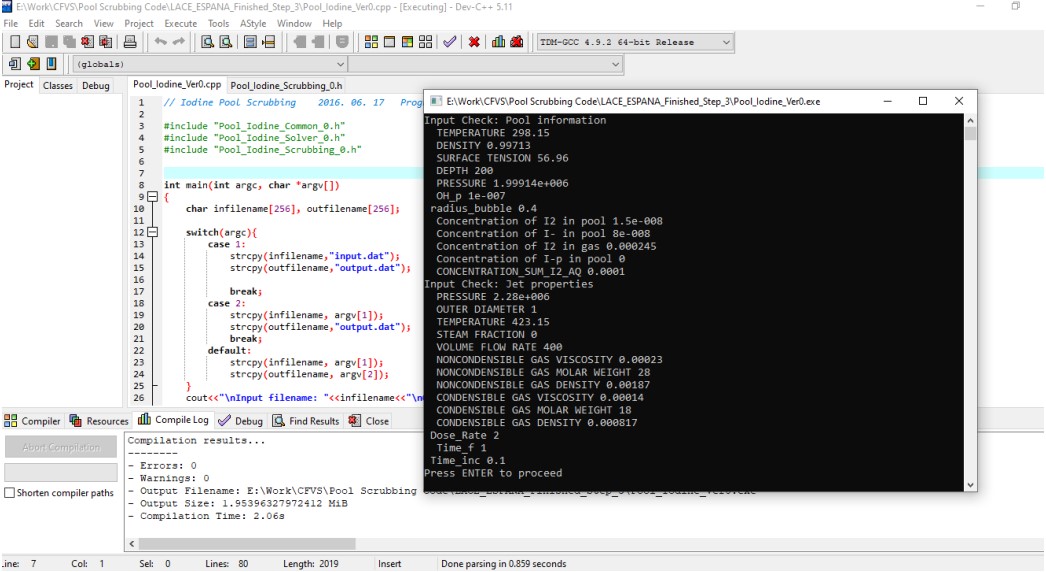
IRIS code also used to evaluate and verify the dependence of DF on variety of factors of the ESPANA Experimental facility. The DF values provided by IRIS code are also compared with SPARC code. They show that the calculated DF values obtained by IRIS code are lower in the magnitude thantheir calculated by SPARCcode. However, in general, the results obtained from both these codes have the same tendency. This difference can be explained that IRIS code focuses only the swarm region where the diffusion of volatile iodine in the tiny bubbles to the aqueous phase and reaction of iodine with water and/or water radiolysis products because the iodine retention by radiolysis will dominate in the swarm region. region. Meanwhile, SPARC code without consideringa water radiolysis.
This research is needed in order to predict the extent of iodine release in a variety of environments as well as the conditions under which it will condense, react, or remain in the vapor state .That is also the basis for taking the right action to minimize the release of fission products spread into the environment.
The above findings are the research results of the Ph.D. thesis entitled “An Evaluation of Volatile Iodine in a Pool under Severe Accident Conditions” by Nguyen Thi Thanh Thuy, Ph.D., a researcher working at Nuclear Energy Center, Institute for Nuclear Science and Technology (INST). The thesis was conducted at the Korea Atomic Energy Research Institute (KAERI), South Korea.
Dr. Nguyen Thi Thanh Thuy
INST


.png)