

Study of proton radiative capture (p,γ) at low energies
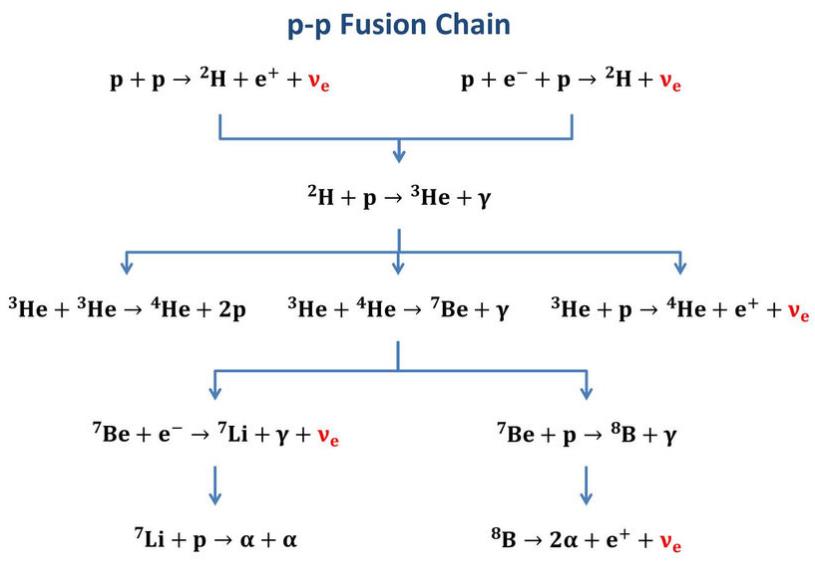
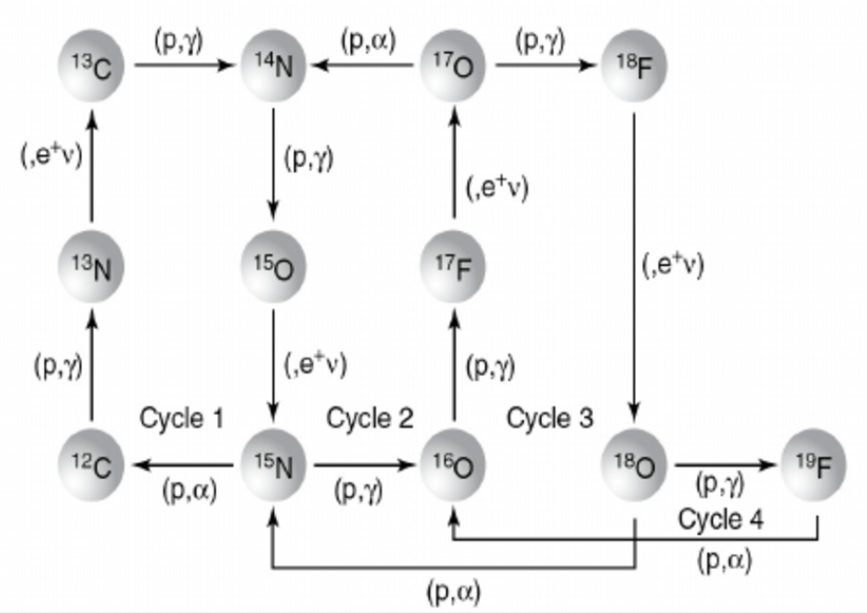
After the Big Bang, Hydrogen accounted for about 74% of all matter in the universe. Therefore, the nuclear reactions which occur with the participation of Hydrogen always have an important position in the evolution of the universe. Among those reactions, proton radiative capture (p,γ) plays a prominent role in various astrophysics processes such as nuclear fusion reactions taking place in the evolution of stars, the classical novae, and type I X-ray bursts [1], etc. The closest example may be the sun in our solar system, the core of which is continuing the burning process to synthesize four 1H into 4He by p-p cycle (Figure 1) over the past billions of years. This burning process is the source of energy that powers the sun to shine and is a necessary source of energy for life on the earth. As can be seen in Figure 1, two reactions 2H(p,γ)3He, 7Be(p,γ)8B are two crucial links of the p-p chain. Or in the stars with a mass greater than that of the sun (about 1.5 times the mass of the sun), the burning of 1H fusion to 4He occurs mainly through the Carbon-Nitrogen-Oxygen (CNO) cycle (Figure 2). In this cycle, many reactions (p, γ) are linkages for the CNO cycle.
To study the astronomical objects mentioned above, the reaction cross-section (p, γ) is an important input parameter. For example, to determine the heat generated by a star in a second, we need to determine the rate of reactions occurring in the star through the quantity of the cross-section. The most accurate method of determining the cross-section is the measurement of these reactions at the temperature condition of the stars. However, the performance of experiments under these conditions is challenging for modern nuclear physics. For example, a star has the same mass as the sun, the temperature is about 0.015GK at the core (1 GK corresponds to 1 billion degrees), then the average kinetic energy of the nuclei is about 1.3 keV. Meanwhile, the Coulomb barrier corresponding to the 12C(p,γ)13N reaction is about 2 MeV. The protons and Carbon nuclei can not overcome the Coulomb potential barrier to carry out nuclear reactions according to the usual mechanism but must go through the tunnel effect with a very small probability. Therefore, it is necessary to have theoretical computational models to help predict the cross-section at the energy region corresponding to the temperature of the stars.
|
Figure. 1. p-p cycle |
Figure. 2. CNO cycle |
The reaction cross-section (p,γ) is determined proportional to the matrix element [2,3]

where, ψi and ψf are the wavefunctions of the proton-nuclear system in the initial state (scattering state) and the final state (bound state), respectively. λ is the multipolarity of the electromagnetic transition, and Mλ is the electromagnetic operator. The exact determination of the cross-section (p, γ) depends on the determination of the scattering wave function ψiand the bound wave function ψf. The study of the wave function ψ and the quantities relating to this wave function has been carried out by a research group at the Center for Nuclear Physics, Institute for Nuclear Science and Technology (INST) for many years. However, the energy region of interest usually exceeds 10 MeV. At the low-energy region below the Coulomb threshold, proton-nucleus scattering systems are often dominated by resonance states, and they are very sensitive to nuclear interaction potentials. This requires an accurate potential model to describe these resonance states. Therefore, the determination of the wave function ψi in this energy region is always challenging. Based on the cooperation between the INST’s group and Professor Pierre Descouvemont, an expert in the astrophysics field from the University of Brussels, Belgium, the group has expanded this research direction under the financial support of the ministerial project entitled “Microscopic study of nucleon radiative capture (p,γ) reaction at low energies with nuclear mean field approach”.
One of the remarkable results is that the group have successfully built a code to calculate the reaction cross-section (p, γ). Most of the popular codes for the calculation of the reaction cross-section (p, γ), such as the RADCAP program [4], FRESCO [5], are applied to the case of the local potential. This means the interaction potential depends only on the distance R connected from the proton to the nucleus. However, the proton-nucleus system is a system of fermions (nucleons are fermions) and the wave function of the system must satisfy the antisymmetric property by the Pauli exclusion principle. As a result, the proton-nuclear interaction potential is non-local, and it then depends not only on the coordinate variable R, but also on the coordinate r, which is the coordinate of nucleons in the nucleus. This non-local potential is often approximated in the form of locality with the aim of simplifying calculations. Noticeably, the code is applicable to both local and non-local potentials. Recently, Tian et al. have studied the effects of the non-local potential on some reactions such as 48Ca(n,γ)49Ca, 7Li(n,γ)8Li, and 12C(p,γ)13N [6]. Therefore, investigating the effects of the non-local potential in the (p, γ) reaction is still a new approach and can be expanded.
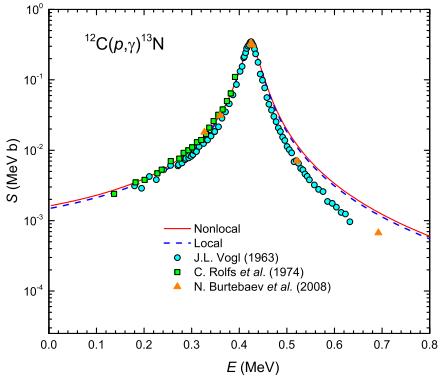
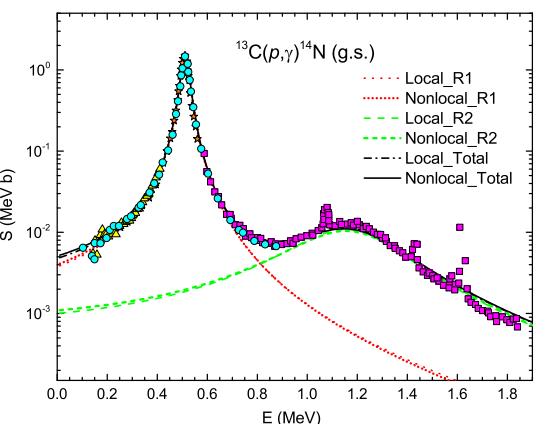
Based on the developed program, the group analyzed the effects of the non-local potential on the S(E) factor of some reactions (p,γ) in the CNO cycle (S(E) factor is determined through the reaction cross-section (p,γ)). Some results on the reactions 12C(p,γ)13N, 13C(p,γ)14N, and 16O(p,γ)17F (Figure 3-5) are noteworthy. The S(E) factor of the reaction 12C(p,γ)13N is dominated by a resonance peak with spin=1/2+ at ER~0.422 MeV (Figure 3). Meanwhile, the S(E) factor of the 13C(p,γ)14N reaction is dominated by two resonance peaks with spin=1- at ER1~0.518 MeV and spin=0- at ER2~1.225 MeV (Figure 4). For these two reactions, it has been found that calculations with non-local potentials result in S(E) about 8% larger than that in the case of local potentials at E~0. Besides, two resonance peaks ER1 and ER2 in the 13C(p,γ)14N reaction were successfully described (Figure 4).
|
Figure. 3. S(E) factor of the 12C(p,γ)13N reaction |
Figure. 4. S(E) factor of the 13C(p,γ)14N reaction |
The 16O(p,γ)17F reaction is an interesting case because the 1/2+ excited state of 17F has a Halo structure. Then, the proton-16O binding wave function of 17F in the 1/2+ excited state has a long tail form at the large radius. This feature is shown by the S(E) factor corresponding to the proton capture reaction to the 1/2+ excited state of 17F which increases when the energy E decreases to zero (Figure 5). From the analysis results, the group found that the non-local effect has no significant influences on the S(E) factor in the astronomical energy region with the reaction 16O(p,γ)17F. The difference S(E) in the calculation of the local and non-local potentials is only less than 5%. The analysis results of 12C(p,γ)13N (Figure 3), 13C(p,γ)14N (Figure. 4), and 16O(p,γ)17F (Figure 5) were published in two renowned Q2 ISI journals [7,8].
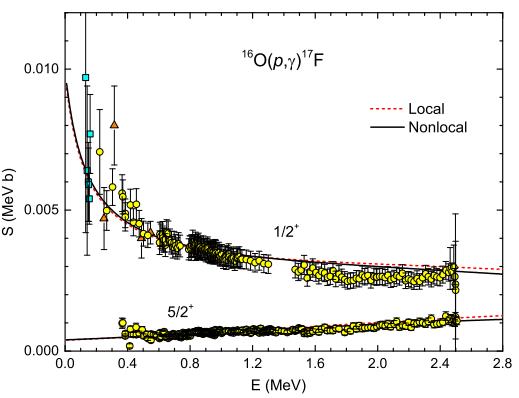
Figure 5. S(E) factor of the 16O(p,γ)17F reaction
The above results are the first research achievements of the group in the nuclear astrophysics field. They encourage the group to continue the implementation of this interesting research direction in the future. From these results, the group will develop studies of (p,γ) reactions based on different microscopic potential models. The group would like to thank the leaders of the INST and Vietnam Atomic Energy Institute for their financial support to the ministerial project "Microscopic study of nucleon radiative capture (p,γ) reaction at low energies with nuclear mean field approach”.
Nguyen Hoang Phuc – Center for Nuclear Physics
INST
References:
[1] Carl R. Brune1 and Barry Davids, “Radiative Capture Reactions in Astrophysics”, Annu. Rev. Nucl. Part. Sci. 2015. 65:87–112(2015).
[2] J.T. Huang, C.A. Bertulani, V. Guimaraes, “Radiative capture of nucleons at astrophysical energies with single-particle states”, At. Data Nucl. Data Tables 96 (2010) 824.
[3] Bruno Marques Braizinha, PhD. Thesis, “Calculation of nuclear reaction rates in astrophysical processes”, University of Lisbon (2004).
[4] C.A. Bertulani, “A potential model tool for direct capture reactions”, Comput. Phys. Commun. 156 (2003) 123.
[5] I. J. Thompson, “Coupled Reaction Channels Calculations in Nuclear Physics”, Comput. Phys. Rep. 7, 167 (1988); http://www.fresco.org.uk.
[6] Y. Tian, D.Y. Pang, Z.Y. Ma, “Effects of nonlocality of nuclear potentials on direct capture reactions”, Phys. Rev. C 97 (2018) 064615.
[7] N. L. Anh, N. H. Phuc, D. T. Khoa, L. H. Chien and N. T. T. Phuc, “Folding model approach to the elastic p+12,13C scattering at low energies and radiative capture 12,13C(p,γ) reactions”, Nuclear Physics A 1006 (2021) 122078.
[8] N. H. Phuc, N. T. T. Phuc, D. C. Cuong, “Study of nonlocality effects in direct capture reactions with Lagrange-mesh R-matrix method”, Journal of Modern Physics E 30, (2021) 2150079.


.png)